
 © Eduardo Soteras Jalil / WBG/Development Data Group
Psychological constructs related to agency—goal-setting capacity, self-efficacy, locus of control—are linked to economic outcomes and well-being across a growing body of evidence. But the tools we use to measure them were developed and validated in Western, high-income contexts. Using them as-is in lower-income settings risks measuring the wrong thing or measuring the right thing badly.
In a new working paper, we introduce and validate four scales built for lower-income settings: goal-setting capacity (GSC), agricultural self-efficacy (AGSE), generalized livelihoods self-efficacy (GLSE), and a short-form locus of control (S-LOC). Each targets a construct that is both foundational to individual agency and empirically linked to socioeconomic outcomes.
What we did
As part of the Measures for Advancing Gender Equality (MAGNET) initiative, we tested these scales in nine surveys spanning six countries in Sub-Saharan Africa—Kenya, Malawi, Tanzania, Uganda, Benin, and Côte d'Ivoire—with over 38,000 respondents. Samples range from nationally representative household surveys to specialized populations: refugee farmers in northern Uganda, factory workers near Abidjan, young entrepreneurs in Kenya and female market vendors in Kampala. This variation helps us understand whether the tools work well across populations, not just within a single sample.
The scales were purposefully designed to reflect the daily realities of women (and men) in these contexts. The AGSE asks about confidence in activities like identifying the best crops to plant or obtaining transport to market. The GLSE captures confidence in one's resources and skills for income generation alongside perceived control over economic decisions—like whether to work outside the home or how household resources are allocated. These are constraints that matter for the populations we work with.
Measurement properties
Three of the four scales (GSC, AGSE, GLSE) show strong reliability and validity across contexts. Their measurement properties also reveal how respondents understand these constructs. For goal-setting, goal clarity does not emerge as distinct from goal creation and action: the two dimensions that matter are setting clear and actionable goals and believing in the importance of goal-setting. For agricultural self-efficacy, respondents distinguish activities by type (planting vs. labor supervision vs. market engagement) more than by underlying behavior (searching for a resource vs. using it). For the GLSE, respondents treat self-confidence as a distinct resource for income generation, separate from information, financial and social support, and skills, which all move together.
Locus of control shows strong validity but weaker internal consistency—partly mechanical (standard reliability tests penalize scales that deliberately include opposing components) and partly reflecting genuine cultural variation in how respondents perceive external forces affecting their lives.
Across scales, 5-point Likert response scales consistently outperform 3-point alternatives on measurement properties without reducing respondent comprehension (which had been an open question in the literature). We also find no evidence that item order within scales matters.
Agency, economic outcomes, and gender
All four constructs are significantly associated with subjective well-being, and the relationship with expected life satisfaction tends to be larger than with current life satisfaction—consistent with agency operating partly through an aspirations channel.
On economic outcomes, GLSE has the strongest and most consistent associations. A one SD increase is associated with a 5–9 pp increase in the probability of working, 2–4 additional hours worked per week, and $10–$13 higher weekly earnings across Kenya and Tanzania. In the Kenya Youth Employment and Opportunities Project (KYEOP) sample, where half the respondents are entrepreneurs, GLSE is also positively associated with business ownership (9 pp for women, 11 pp for men) and business profits. GSC shows a 3–7 pp increase in women's probability of working and about 2 additional hours per week across Kenya, Malawi, and Tanzania. Locus of control is more context-specific, with positive associations in Malawi and Uganda but a negative relationship among Côte d'Ivoire factory workers—likely reflecting differences in both sample characteristics and the economic meaning of perceiving control in different labor market settings.
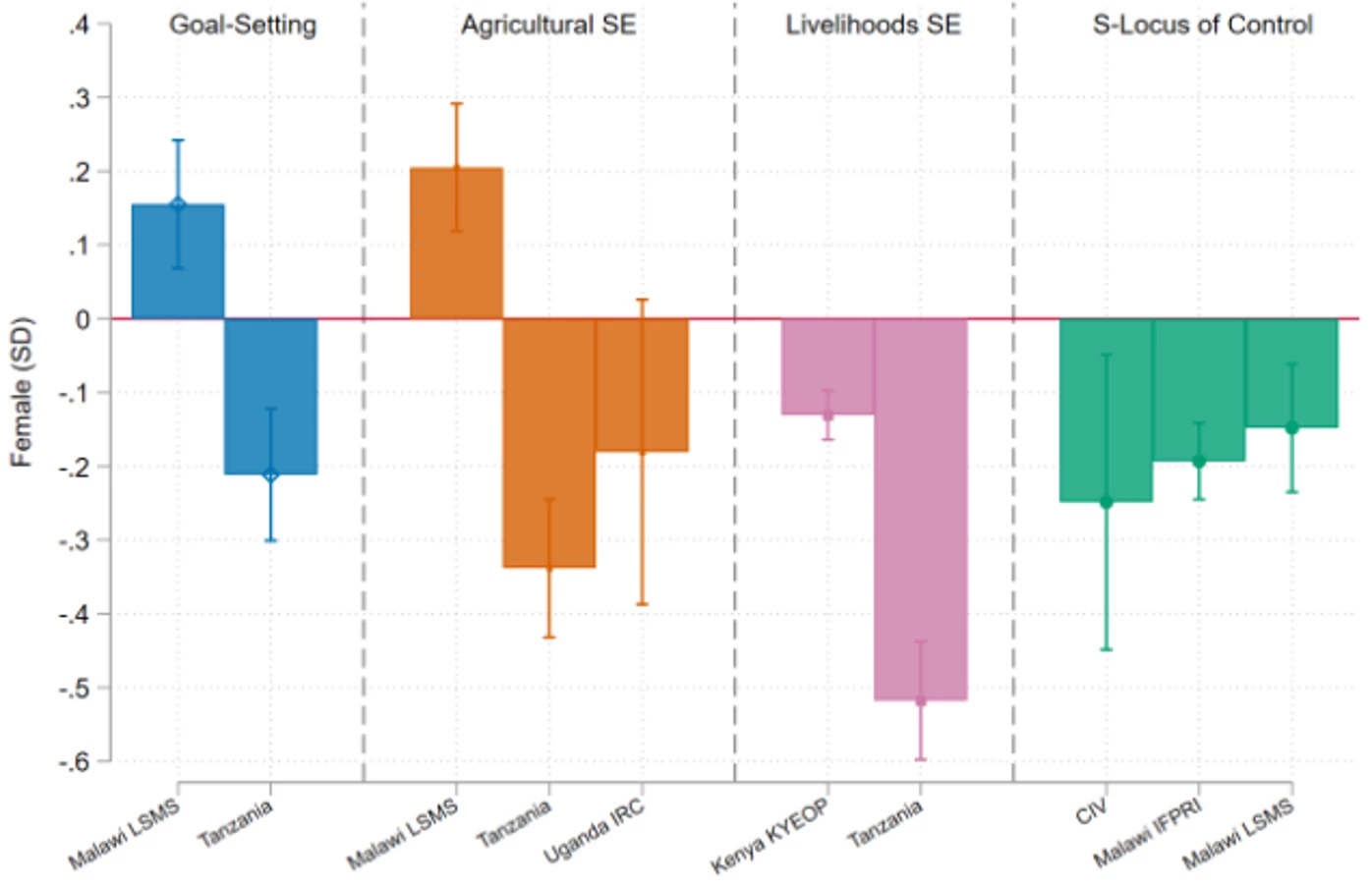
The gender patterns are also worth highlighting. Women have lower average levels of agency than men across most constructs and contexts (Figure 1).
Figure 1: Women report lower agency than men in most contexts
But agency also matters more for women's outcomes in several domains. GSC, GLSE, and locus of control are generally more predictive of female labor supply than male labor supply. The relationship between agency and intra-household decision-making is at least twice as large for married women as for married men in every context where we can compare. Moreover, GLSE is negatively associated with women's experience of intimate partner violence in Kenya: a one SD increase is linked to a 3 pp reduction in reported lifetime IPV.
For earnings and food security, however, agency matters more for men than for women—suggesting different pathways through which agency translates into economic outcomes by gender.
What this means
Development programs increasingly try to target internal constraints (such as goal-setting or sense of control), not just external ones (like credit or training). But assessing whether a program actually worked—and how—is difficult without the right measurement tools. Validated for use from nationally representative surveys to impact evaluations, these scales make that measurement possible: tracking whether an intervention shifted agency itself, not just its downstream effects, and identifying where psychological barriers hold back economic participation, particularly for women.
This research is part of the Measures for Advancing Gender Equality (MAGNET) initiative, a cross-institutional effort to improve measurement of women’s agency and empowerment across development contexts.



Join the Conversation